
Governing at the speed of AI


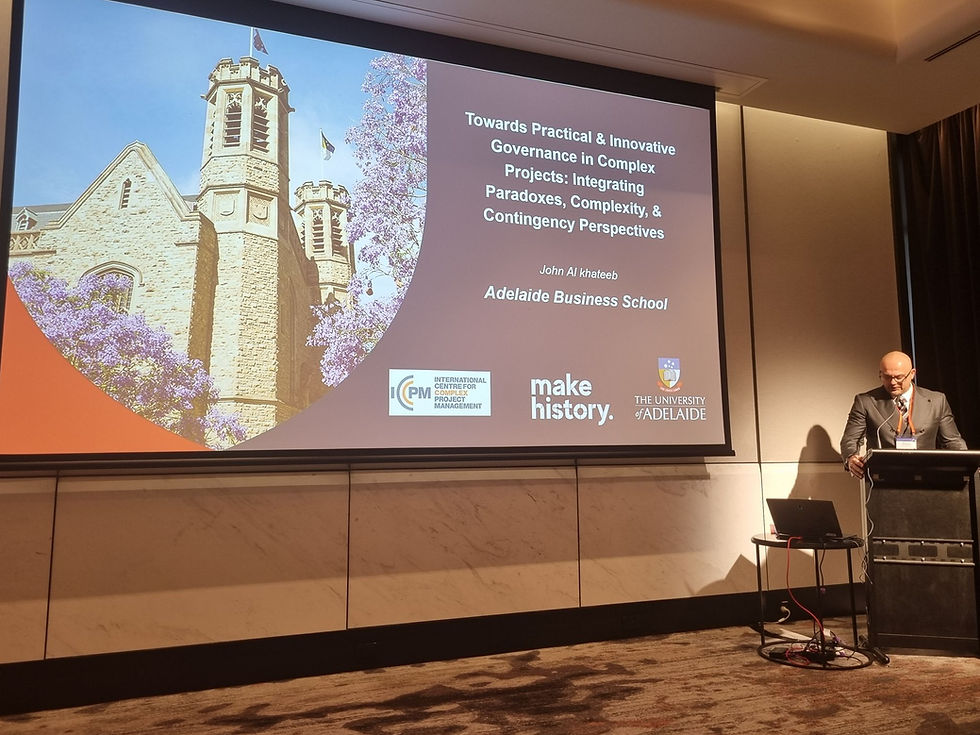
On 13 August 2026, INMAA Advisory's John Al Khateeb presented "Governing at the Speed of AI" to the PMI Adelaide Chapter. The talk argued that as AI systems generate signals, options, and recommendations faster than organisations can absorb them, the constraint on good governance is no longer information — it is the capacity of people and governance structures to make sense of that information and decide. Governing well at AI speed means confronting that constraint directly.
The problem: organisational bandwidth
Most discussion of AI in project environments focuses on what the technology can produce. The presentation reframed the question around what an organisation can process. When an AI system surfaces more signals in an hour than a steering committee can consider in a month, the bottleneck shifts from generating insight to acting on it. INMAA describes this limit as organisational bandwidth: the rate at which humans and governance mechanisms can turn signals into decisions. Add capacity on the AI side and the bandwidth gap widens rather than closes.
This matters for governance specifically. Boards and assurance mechanisms are designed around human review cycles — meetings, papers, approvals. Those cycles set a natural speed limit. AI does not respect that limit, and the mismatch is where governance either adapts or falls behind.
What governing at AI speed requires
The talk set out that closing the gap is not primarily a technology problem. Three shifts matter more:
Governance has to become faster at sensemaking without lowering its standards — distinguishing signals that warrant a decision from noise that does not. It has to distribute decision rights so that not every judgement escalates to the same overloaded forum. And it has to build the capability to work alongside AI outputs critically, rather than either deferring to them or ignoring them.
None of this removes established governance practice. Risk management, accountability, and assurance remain essential. The point is that they now operate in an environment where the volume and speed of inputs have changed, and the governance system has to change with them.
INMAA's angle
INMAA's approach to this rests on tension-informed decision-making. In complex, fast-moving environments, governance generates persistent tensions — speed versus assurance, autonomy versus control — that cannot be permanently resolved. INMAA treats these tensions as early-warning signals about where a system is under strain, alongside conventional risk management rather than in place of it. Under AI acceleration, those tensions surface faster and more often, which makes reading them a practical governance skill rather than an abstract one.
The presentation also drew on INMAA's work on AI-enabled governance support — tools that help organisations process complex signals and surface what warrants attention, so that added AI capacity extends organisational bandwidth instead of overwhelming it.
Frequently asked questions
What does "governing at the speed of AI" mean?
It means adapting governance so that decision-making can keep pace with the volume and speed of signals AI produces, without abandoning the standards of assurance and accountability that governance exists to provide.
What is organisational bandwidth?
It is the rate at which an organisation's people and governance structures can turn information into decisions. When AI generates signals faster than that rate, the organisation — not the technology — becomes the constraint.
Does this replace traditional risk management?
No. Risk management remains central. INMAA's tension-informed approach works alongside it, treating persistent governance tensions as additional early-warning signals rather than as a substitute for risk practice.


Comments